

Superyachts for Sale: The Definitive Buyer’s Guide for 2026
If you believe the greatest challenge in maritime acquisition is simply finding a vessel, you're likely only seeing the tip of the iceberg. While the global market for superyachts for sale reached a staggering 4.56 billion dollars in the first half of 2026, the real complexity lies in the details that don't appear in a glossy brochure. You shouldn't have to face opaque off-market listings or the labyrinth of international maritime law without a steady hand to guide you.
We understand that you're looking for more than just a boat; you're seeking a seamless extension of your lifestyle without the burden of hidden maintenance costs or wasted weeks on fruitless physical inspections. This guide serves as your professional mentor, offering the clarity you need to master the acquisition process with confidence. We'll walk you through the nuances of expert buyer representation, the efficiency of high-fidelity 3D virtual tours for remote vetting, and the strategic negotiation tactics required to secure a fair price. By the end of this article, you'll have a clear roadmap to handle the 2026 market and claim your place on the water with absolute peace of mind.
Key Takeaways
- Identify high-value opportunities in the 2026 market by focusing on the rise of explorer yachts and the latest advancements in sustainable propulsion.
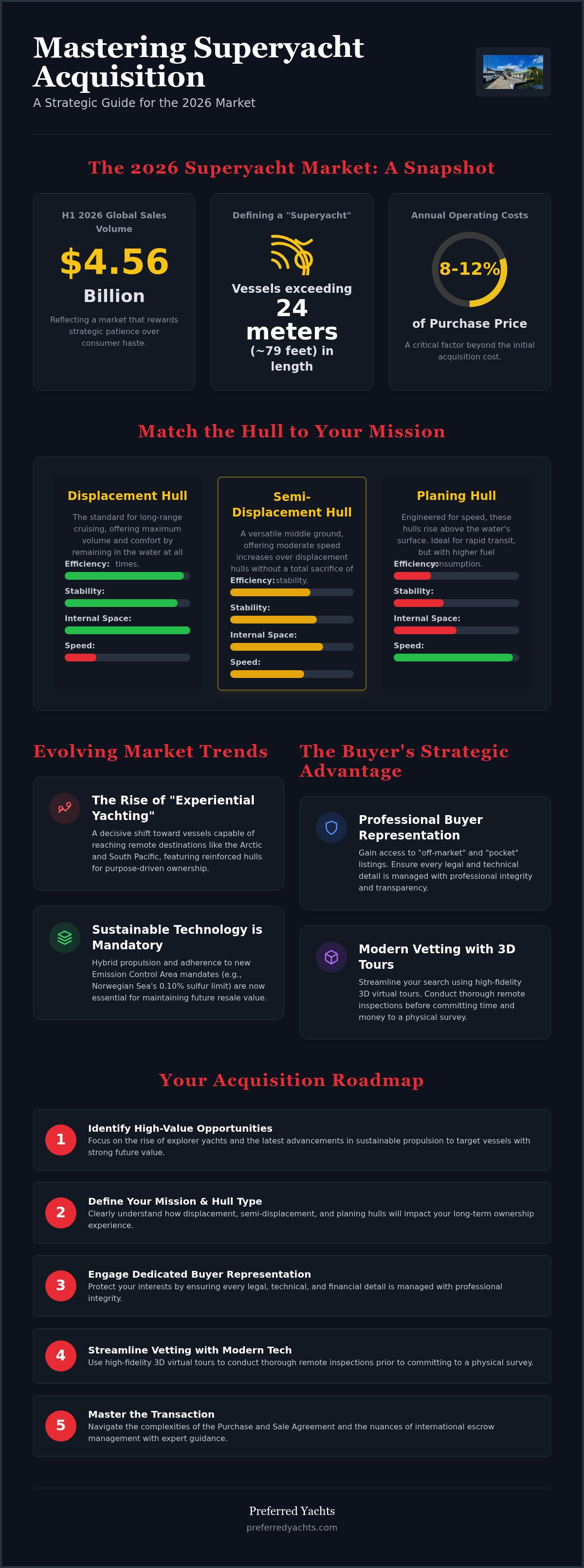
- Navigate the diverse inventory of superyachts for sale with a clear understanding of how displacement, semi-displacement, and planing hulls impact your long-term ownership experience.
- Protect your interests through dedicated buyer representation, ensuring every legal and technical detail is managed with professional integrity and transparency.
- Streamline your search using modern vetting techniques, including high-fidelity 3D virtual tours that allow for thorough remote inspections prior to a physical survey.
- Secure your investment by mastering the complexities of the Purchase and Sale Agreement and the nuances of international escrow management.
Understanding the Superyacht Market in 2026
The term "superyacht" isn't merely a synonym for luxury; it's a technical classification for vessels that exceed 24 meters (approximately 79 feet) in length. Understanding What is a Superyacht? requires looking past the teak decks to the complex engineering and regulatory frameworks that govern these floating estates. In 2026, the market for superyachts for sale has reached a sophisticated equilibrium where buyers prioritize long-term utility over immediate prestige. Data from the first half of 2026 shows a total sales volume of 4.56 billion dollars, reflecting a market that rewards those who approach acquisition with a mentor’s patience rather than a consumer’s haste.
Relying on simple price-comparison tools is a mistake in this tier of the market. These tools often fail to account for the "off-market" sector, where many of the most desirable vessels are traded quietly to protect the privacy of both parties. A professional market analysis goes deeper, examining the 8% to 12% annual operating costs and the impact of new environmental mandates. For instance, as of March 1, 2026, the Norwegian Sea became a designated Emission Control Area, requiring yachts to use fuel with a sulfur content of 0.10% or less. A true advisor ensures you don't buy a vessel that's technologically obsolete before it even leaves the dock.
The Evolution of Luxury Yachting Trends
The traditional Mediterranean cruising circuit is no longer the sole focus of the industry. We're seeing a decisive shift toward "Experiential Yachting," where owners demand vessels capable of reaching remote destinations like the Arctic or the South Pacific. Naval architecture has responded with hybrid propulsion systems and reinforced hulls that allow for purpose-driven ownership. 2026 stands as the benchmark year when sustainable technology moved from a niche request to a mandatory requirement for maintaining future resale value.
Why National Market Access Matters
Limiting your search to local marinas or public portals significantly narrows your opportunities. Serious acquisition requires national market access to uncover "pocket listings" that never reach the open market. You can use our curated list of brokerage boats and yachts as a starting point to understand the current inventory and pricing trends. A brokerage doesn't just show you what's available; they provide the historical context and technical vetting necessary to distinguish a fair deal from a hidden liability. By looking beyond your immediate geographic hub, you gain the leverage needed to find superyachts for sale that truly align with your specific mission and lifestyle requirements.
Categorizing the Fleet: Motor Yachts, Sailing Yachts, and Lifestyle Missions
Selecting the right vessel from the pool of superyachts for sale requires a disciplined assessment of your "Mission Profile." You must look beyond the aesthetic appeal to determine how the yacht's engineering aligns with your intended use. A vessel designed for Mediterranean weekend entertaining possesses a fundamentally different DNA than one built for transoceanic exploration. Defining your mission early prevents the costly mistake of acquiring a platform that can't support your lifestyle. This process includes weighing specialized categories like explorer yachts for high-latitude cruising, sportfishers for tournament-level utility, or classic refits for those who value maritime heritage.
The hull design is the most critical technical decision you'll make. Displacement hulls offer the highest volume and fuel efficiency, making them the standard for long-range cruising. They remain in the water at all times, providing a stable, comfortable motion even in rougher seas. Planing hulls, conversely, are designed to rise above the water's surface to achieve high speeds. While they allow for rapid transit between ports, they require significantly more fuel and offer less internal space. Semi-displacement hulls provide a versatile middle ground, offering moderate speed increases without sacrificing total stability at anchor.
Motor Yachts: Power, Space, and Amenities
Motor yachts dominate the market because they maximize guest comfort and social space. Multi-deck configurations allow for a clear separation between crew operations and guest privacy, which is essential for longer voyages. When evaluating these vessels, consider the trade-offs between speed and efficiency. A yacht capable of 30 knots will have a much shorter range than a displacement vessel cruising at 12 knots. Modern buyers in 2026 prioritize features like expansive beach clubs, helipads, and advanced zero-speed stabilizer systems to ensure comfort both at sea and in the harbor.
Sailing Yachts: The Art of Performance
For the purist, a sailing yacht offers a serene connection to the ocean that engines can't replicate. These vessels appeal to those who view the journey as the primary objective. However, they introduce technical complexities that motor yachts avoid. Rigging, sail handling systems, and keel configurations require specialized knowledge and a crew with specific sailing expertise. Performance cruisers utilize carbon fiber and advanced naval architecture to offer impressive speed, while traditional offshore yachts focus on heavy-displacement stability for safe blue-water crossings.
If you're unsure which hull type or propulsion system best suits your intended itinerary, we invite you to explore our current listings for a practical comparison of these platforms. Matching the vessel to your specific mission is the first step toward successful ownership.
The Critical Importance of Professional Buyer Representation
Acquiring a high-value maritime asset is a legal and technical undertaking that demands a level of protection far beyond a simple sales transaction. A buyer agent's primary role is to uphold a fiduciary duty to you, meaning they're ethically and legally bound to prioritize your interests above all else. In a market where superyachts for sale often involve complex international ownership structures, having a mentor to navigate these waters isn't just a luxury; it's a necessity for risk mitigation. Your representative acts as the central hub, coordinating a specialized team that includes maritime lawyers, technical surveyors, and experienced captains to ensure every facet of the vessel is scrutinized.
Expert negotiation in 2026 relies on hard data rather than emotional appeals. While the total sales volume for the first half of the year reached 4.56 billion dollars, the market also saw a 4.5% year-over-year increase in price reductions. A professional representative uses this historical sales data and market analysis to justify offers that reflect a vessel's true value, often securing terms significantly below the initial asking price. They understand that a fair deal is built on documented facts, operational history, and the projected cost of ownership.
Listing Agent vs. Buyer Agent: Knowing the Difference
Relying solely on a listing broker can create a "dual agency" environment where your interests may be secondary to the seller's goals. The listing agent's contract is with the seller to achieve the highest possible price; a buyer agent's contract is with you to find the best possible vessel at the most favorable terms. Because the sales commission is typically shared between the two brokerages, this level of professional buyer representation is usually provided at no direct out-of-pocket cost to the purchaser. This allows you to gain an unbiased perspective on a vessel’s flaws without financial conflict.
Personalized Search and Market Analysis
The most exclusive opportunities rarely appear in a public search bar. A dedicated advisor provides access to "pocket listings" and off-market vessels that match your specific mission profile. They move beyond generic recommendations, providing deep-dive market analysis that compares a yacht's current condition against its peers. By analyzing the 80 superyachts over 30 meters sold in the first quarter of 2026, a skilled broker can identify pricing trends and value gaps that an unrepresented buyer would likely miss. This tailored approach ensures you spend your time only on vessels that meet your exacting standards.
Modern Vetting Techniques: From 3D Virtual Tours to Physical Surveys
The transition from browsing superyachts for sale to executing a purchase requires a shift from aesthetic appreciation to technical skepticism. In the 2026 market, where the average new build length has reached 48.5 meters, the complexity of onboard systems makes traditional walkthroughs insufficient. Vetting is no longer just about the first impression; it's about verifying the structural and mechanical integrity of a floating asset that may cost millions to maintain. This phase is where your representative’s role as a mentor becomes most visible, ensuring that every claim made in a listing is backed by documented performance.
The Power of 3D Virtual Yacht Tours
Remote vetting has been revolutionized by 3D virtual tour production, allowing you to eliminate unsuitable vessels before booking a single flight. These immersive walkthroughs provide high-fidelity digital detail for remote inspections, enabling your captain or family office to scrutinize the layout and condition of the engine room, crew quarters, and technical spaces from anywhere in the world. By using these digital tools, you can conduct a national search with surgical precision, focusing your physical travel only on the vessels that have already passed a rigorous digital pre-screening. It's a method that respects your time and ensures that the physical survey is a confirmation of quality rather than a discovery of flaws.
The Comprehensive Sea Trial and Survey Process
Once a vessel passes the digital vetting stage, the physical pre-purchase survey begins. Selecting a marine surveyor with specific expertise in superyacht construction is vital, as they must evaluate everything from the hull's composite integrity to the complex electronics of the bridge. During the sea trial, the vessel is tested under full load to verify that stabilizers, thrusters, and power management systems perform as intended. A cold start of the main engines is a non-negotiable requirement to identify hidden wear that might be masked if the engines are pre-warmed.
- Technical Diagnostics: We utilize oil analysis and thermal imaging to detect internal engine wear and electrical hot spots that aren't visible to the naked eye.
- Logbook Review: A thorough audit of engine room logs and maintenance history reveals if the crew followed the manufacturer's recommended service intervals.
- Environmental Compliance: Surveyors now verify compliance with 2026 IMO regulations, such as the prohibition of PFOS-containing firefighting foams and the new NOx emission standards for specific regions.
The findings from this process serve as your final negotiation lever. If a survey uncovers significant deferred maintenance, you have the data needed to request a price adjustment or require the seller to make repairs before closing. To see how we bring this level of detail to your search, you can view our latest 3D virtual tours and experience the future of yacht vetting today.
Executing the Transaction: Negotiating and Closing Your Purchase
The final stage of acquiring a vessel is a disciplined legal exercise where the initial handshake meets the rigor of maritime law. In a market where buyers are increasingly value-conscious, the closing process requires more than just a transfer of funds; it demands a meticulous audit of the "Purchase and Sale Agreement" (PSA). This document must include essential clauses that protect your deposit and ensure the sale is contingent upon a satisfactory survey and sea trial. Escrow management is equally vital, providing a neutral territory where your capital remains secure until every technical and legal condition is met. When you're looking at superyachts for sale, the transaction isn't complete until the title is verified as clear and all encumbrances are removed.
Negotiation in 2026 has become a nuanced dialogue. With interest rates for well-qualified borrowers in the US starting at approximately 6.49%, many buyers use financing as a strategic tool to preserve liquidity. A professional representative leverages these financial realities, along with the 4.5% increase in market-wide price reductions, to ensure you aren't overpaying for a depreciating asset. We focus on the total cost of ownership, helping you understand that the purchase price is only the beginning of your financial commitment.
Closing Logistics and Documentation
International sales introduce complex layers of bureaucracy, particularly regarding flagging and VAT. For instance, as of January 1, 2026, French VAT regulations changed for non-EU entities; those importing a yacht under Regime 42 must now have their own French VAT registration. Selecting the right jurisdiction for flagging isn't just about taxes; it affects your crew requirements and where you can legally charter. Our brokerage manages this paperwork, verifying that no outstanding maritime liens exist and that the vessel's registration is handled with precision to avoid future operational delays.
Post-Closing: Your First 90 Days of Ownership
Transitioning from a buyer to an owner is a significant shift that requires a structured 90-day plan. This period focuses on establishing management structures, securing insurance premiums (which typically range from 0.5% to 1.5% of the vessel's value), and hiring a crew that understands the specific mission of your yacht. We act as your mentor during this phase, recommending vetted service yards for initial upgrades and ensuring your captain is briefed on the latest environmental regulations. Remember the "10% rule": your annual running costs will likely stay between 8% and 12% of the vessel's value, so setting up an efficient budget early is critical for long-term enjoyment.
The journey to ownership is complex, but you don't have to walk it alone. View our current national listings and start your search today.
Charting Your Course to Successful Yacht Ownership
Navigating the complex landscape of superyachts for sale in 2026 requires a disciplined blend of modern technology and traditional maritime expertise. You've seen how high-fidelity 3D virtual tours can streamline your search and how dedicated buyer representation protects your interests from the first offer to the final closing. Success on the water isn't just about the vessel you choose; it's about the team of experts you assemble to ensure your investment remains a source of joy rather than a logistical burden.
Since 1984, we've provided the mentor-led guidance necessary to manage complex maritime transactions with absolute precision. Our professional 3D virtual tours for every major listing allow you to vet vessels with confidence from anywhere in the world. When you're ready to move beyond the search bar and find a vessel that truly matches your lifestyle, we're here to provide the steady hand you need. Explore our exclusive buyer representation services and national listings. Your journey to the horizon begins with a single, well-informed step.
Frequently Asked Questions
What is considered a superyacht vs. a megayacht in 2026?
A superyacht is technically defined as a vessel exceeding 24 meters, or approximately 79 feet, in length. While the terms are sometimes used interchangeably, a megayacht typically refers to vessels that surpass 60 meters, or 200 feet. In 2026, the average length of new builds has reached 48.5 meters, pushing the boundaries of what owners expect from the standard superyacht category.
Do I need a broker to buy a yacht if I found it online?
Professional representation is essential even if you locate a vessel through public portals. A buyer's broker provides fiduciary protection and manages the team of experts required for a safe transaction. Most importantly, brokers provide access to the off-market sector, where many high-quality superyachts for sale are traded privately without ever appearing on public websites.
How much does a yacht broker commission cost for the buyer?
Buyer representation is typically a no-cost service for the purchaser. The sales commission is generally paid by the seller and then shared between the listing brokerage and the buyer's brokerage. This structure allows you to have a dedicated mentor protecting your interests during negotiations without adding a direct fee to your acquisition costs.
What are the typical annual operating costs of a superyacht?
The standard industry estimate for annual running costs is between 8% and 12% of the vessel's total value. For example, a yacht valued at 20 million euros will typically require between 1.6 million and 2.4 million euros per year for maintenance, crew, insurance, and fuel. These costs can vary based on your mission profile and whether you choose to charter the vessel.
How do 3D virtual tours help in the yacht buying process?
High-fidelity 3D virtual tours allow you to conduct a detailed remote inspection of a vessel's layout and technical spaces before committing to physical travel. This technology enables your captain and family office to collaborate on vetting multiple superyachts for sale across the country simultaneously. It's a precise method that eliminates unsuitable vessels early and focuses your time only on high-probability acquisitions.
What is the role of a marine survey in a superyacht purchase?
A marine survey provides an objective, technical evaluation of a vessel's structural and mechanical integrity. Conducted by a specialized surveyor, this process includes sea trials, oil analysis, and thermal imaging to uncover hidden issues. The final survey report serves as a critical negotiation lever, allowing you to request price adjustments or repairs before the transaction is finalized.
How long does the yacht closing process typically take?
The closing process for a superyacht usually takes between 30 and 60 days from the signing of the Purchase and Sale Agreement. This timeline accounts for the inspection period, the technical survey, and the complex logistics of international flagging and registration. Delays can occur if the vessel requires specific VAT registrations, such as the new French requirements introduced in early 2026.