

How to Buy an Offshore Yacht: The Complete Guide for 2026
An offshore yacht purchase isn't a retail transaction; it's a high-stakes risk management project where a single overlooked structural flaw can cost six figures in repairs. You've likely spent years dreaming of blue water passages and the freedom of the open sea, but the reality of the 2026 market can feel daunting. Between fluctuating luxury prices and the fear of hidden defects, it's natural to feel hesitant. If you're wondering how to buy an offshore yacht without falling into common traps, you're in the right place.
We understand that your goal is a sea-kindly vessel that offers both safety and value. This expert-led guide simplifies the complexities of acquisition, from initial selection to the final handshake. You'll learn how to use 3D virtual tours for remote filtering, handle the latest IMO registration standards, and manage the intricate closing documentation that ensures a clear title. By following this structured path, you'll move from initial offer to ownership with the peace of mind that only professional due diligence provides.
Key Takeaways
- Distinguish between true blue water vessels and coastal cruisers by evaluating hull integrity and stability ratings essential for safe ocean passages.
- Learn how to buy an offshore yacht more efficiently by leveraging 3D virtual tours to filter national inventory and verify maintenance logs before traveling.
- Protect your financial interests with a structured Purchase and Sale Agreement that utilizes secure escrow accounts and specific performance contingencies.
- Identify hidden structural risks through a multi-disciplinary survey process, including a mandatory haul-out to inspect the hull and running gear.
- Navigate the closing process with professional buyer representation to ensure fiduciary advocacy and a seamless transition of title at no direct cost to you.
Defining the Offshore Yacht: Blue Water vs. Coastal Cruising
Many buyers begin their search by looking for a specific brand, such as Offshore Yachts, but soon realize that "offshore" describes a rigorous engineering standard rather than just a nameplate. Understanding what is an offshore yacht requires looking past the aesthetic finishes to the structural integrity beneath the waterline. When you're researching how to buy an offshore yacht, your primary focus must be on the vessel's ability to handle conditions far beyond the safety of a coastal harbor.
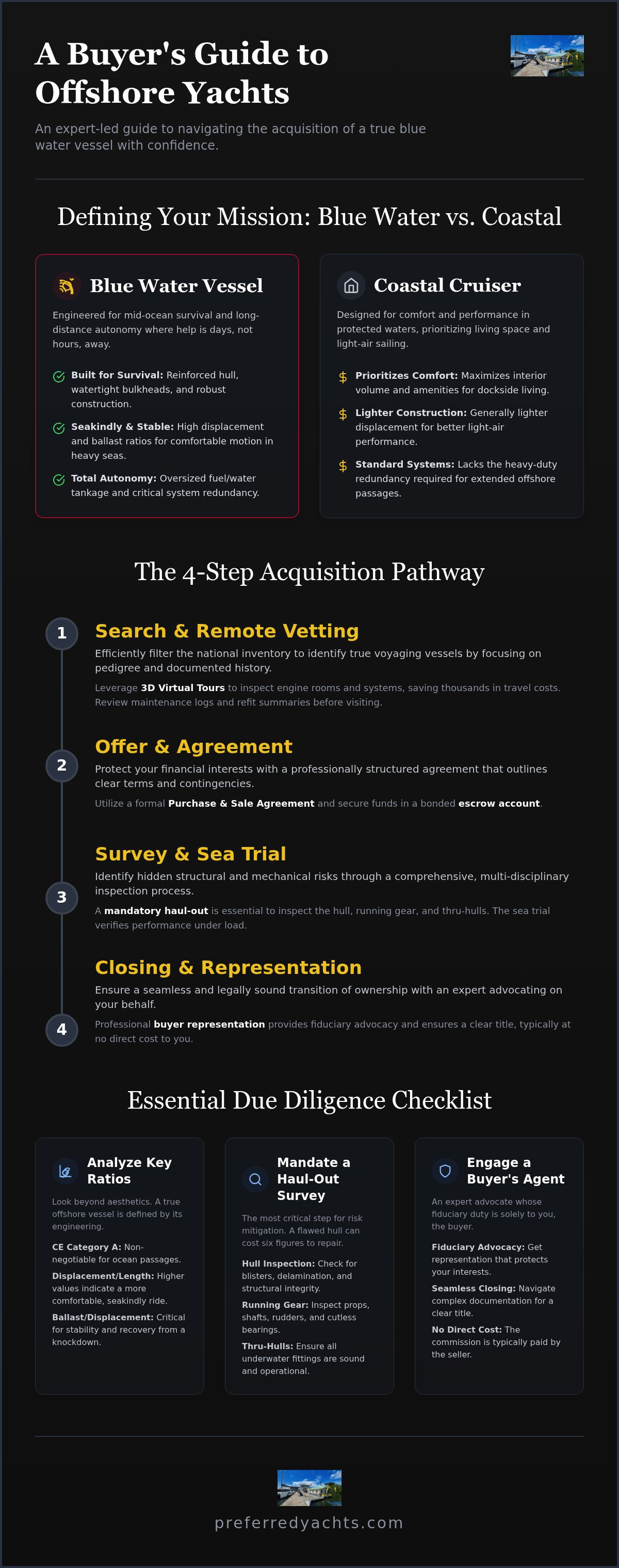
The distinction between a coastal cruiser and a blue water vessel lies in autonomy. Coastal yachts, often used for the Great Loop or island hopping, prioritize living space and light-air performance. In contrast, a blue water yacht is built for mid-ocean survival. This includes reinforced hull laminates, watertight bulkheads, and oversized tankage for fuel and water. For 2026 voyagers, these vessels must also feature redundant systems, such as dual fuel filters and backup watermakers, to ensure safety during long-distance passages where help is days away.
Key Specifications for Offshore Capability
The most reliable benchmark for offshore safety is the CE Category A (Ocean) rating. This certification confirms a boat's design can handle winds exceeding 40 knots and waves over 4 meters. Beyond ratings, experienced buyers look at technical ratios. A high Displacement-to-Length ratio often signals a more comfortable, stable motion in heavy seas, a quality known as seakindliness. While a lighter boat might be faster in a breeze, a seakindly hull prevents the crew fatigue that often leads to accidents during offshore transits. Ballast-to-displacement ratios are equally vital, as they dictate the vessel's ability to recover from a knockdown.
Power vs. Sail: Choosing Your Offshore Platform
Choosing between a long-range trawler and a blue-water sailboat depends on your preferred style of voyaging. Power yachts require massive fuel capacity and engine redundancy, often featuring a dedicated "get-home" engine to mitigate the risk of a primary engine failure. Sailboats offer the ultimate autonomy but require rigging systems designed for shorthanded use. In the 2026 market, look for sailboats with electric furling and simplified sail handling that allow a couple to manage the vessel safely without a full crew. Both platforms require robust stability profiles to ensure they remain upright and controllable when the weather turns.
The Search Phase: How to Evaluate Offshore Candidates
Finding a vessel that matches your blue water ambitions requires a transition from casual browsing to rigorous technical analysis. National listing databases offer a vast inventory, but they often lack the granular detail needed for an offshore assessment. When you're learning how to buy an offshore yacht, your first task is to separate "dock queens" from true voyaging vessels by scrutinizing the pedigree of the builder and designer. Names like Sparkman & Stephens or Robert Perry carry weight because their designs prioritize stability and structural safety over interior volume.
A vessel's history is as important as its design. You should request maintenance logs and refit summaries as early as possible. In the 2026 market, many high-quality yachts are reaching major survey milestones. A yacht that's recently undergone a professional refit of its standing rigging or primary propulsion systems represents significantly higher value than a lower-priced candidate with aging equipment. Your search should prioritize boats where the owner has documented every service interval, as this transparency usually reflects the vessel's overall seaworthiness.
Leveraging 3D Virtual Tours for Remote Selection
The most significant advancement in the 2026 search process is the use of professional 3D virtual tours. These immersive walkthroughs allow you to filter candidates nationally without the expense of immediate travel. You can inspect the engine room layout, check the accessibility of through-hull fittings, and evaluate the ergonomics of the galley for use in a seaway. High-resolution digital inspections reveal the true condition of the cabinetry and bilge areas, ensuring that when you finally do travel for a physical viewing, the boat matches your expectations. This digital-first approach saves weeks of wasted time and thousands of dollars in travel costs.
Filtering by Equipment and Systems
Offshore yachts require a specific suite of equipment that coastal cruisers often lack. You should look for candidates already equipped with high-capacity watermakers, satellite communications, and redundant navigation arrays. Evaluating the state of the standing rigging is critical for sailboats, while power yachts require a deep dive into engine service records. You can explore our current brokerage boats and yachts to see examples of inventory that meet these rigorous offshore standards. If a vessel lacks these essential systems, you must factor the cost of upgrades into your initial offer. Our team of experienced brokers can act as your mentor during this phase, helping you identify which upgrades are essential for your specific cruising goals.
The Acquisition Process: From Offer to Sea Trial
Once you've identified a candidate that meets your technical requirements, the process shifts from evaluation to negotiation. Understanding how to buy an offshore yacht involves more than just agreeing on a price; it requires a structured legal framework that protects your interests. The Purchase and Sale Agreement (PSA) serves as this foundation. It's a binding contract that outlines the price, the timeline for inspections, and the specific conditions that must be met before the sale becomes final. In the 2026 market, where high-quality inventory remains competitive, a clear and professional PSA is your strongest negotiating tool.
Ethical transaction management is essential during this phase. A central component of this is the escrow account, typically managed by a bonded brokerage. Your deposit remains in this account, shielded from the seller's personal finances, until all contingencies are satisfied. If the vessel doesn't meet the standards defined in your contract, this structure ensures a clear path to a full refund. This methodical approach transforms a complex purchase into a series of manageable, low-risk steps.
Crafting a Competitive and Protected Offer
Establishing a fair offer requires looking beyond asking prices. We use recent sold-boat data to determine the actual market value of comparable offshore vessels, ensuring you don't overpay in a fluctuating market. Your offer must include essential contingencies for a professional survey, a sea trial, and financing. A 10% deposit is standard in offshore yachting because it demonstrates serious intent to the seller while providing you with the legal leverage to secure the vessel for a thorough inspection. This deposit is your commitment to the process, but it's always protected by the specific language of your PSA.
The Sea Trial: Testing Performance Under Load
A professional sea trial is a rigorous technical evaluation, not a simple demonstration ride. While a demonstration ride shows you the boat's layout on the water, a sea trial tests the vessel's mechanical limits under load. You should look for consistent performance during high-speed runs and observe how the hull handles maneuvering in various sea states. It's the only time you can truly verify the health of the generators, air conditioning units, and stabilizers while they're working at full capacity.
During this phase, you're looking for vibrations, temperature spikes in the engine room, or failures in hydraulic systems. If the yacht features advanced 2026 stabilization technology, ensure it engages smoothly without excessive noise or lag. Following the sea trial and the subsequent survey, you'll face a critical decision point. You can execute an "Acceptance of Vessel," negotiate for specific repairs or price adjustments, or issue a "Rejection" to walk away with your deposit intact. This disciplined process ensures your transition to ownership is based on facts rather than emotion.
Risk Mitigation: The Survey and Documentation Phase
Acquiring an ocean-going vessel requires a level of scrutiny that goes far beyond a standard boat purchase. When you're determining how to buy an offshore yacht, the survey phase is where you move from optimistic interest to clinical evaluation. A single surveyor, while skilled, rarely possesses the specialized knowledge to inspect every system on a modern offshore yacht. You need a multi-disciplinary team to ensure no hidden structural defects or mechanical failures compromise your safety at sea.
The haul-out is a critical milestone in this process. By lifting the vessel from the water, you can inspect the hull for signs of delamination, osmosis, or previous impact damage that remains invisible while afloat. This is also the only time to examine the running gear, including shafts, struts, and propellers. Once the technical reports are finalized, they become your primary negotiation tool. If a surveyor identifies significant necessary repairs, you have the factual basis to request a price adjustment or a repair credit before proceeding to the final closing.
International documentation adds another layer of complexity to the transaction. For 2026, new IMO guidelines introduce more rigorous due diligence standards for ship registration to prevent fraud. If you're purchasing in Florida, remember that the 6% sales and use tax is capped at $18,000; a vital detail for your closing budget. If you are ready to begin this process with a professional advocate, contact us for expert buyer representation to protect your investment throughout the survey and documentation phase.
Choosing Your Survey Team
Professional certifications matter when selecting your advocates. Look for surveyors accredited by SAMS (Society of Accredited Marine Surveyors) or NAMS (National Association of Marine Surveyors). For offshore yachts, you should also commission a dedicated engine survey. This includes oil analysis and compression testing to identify internal wear that a visual inspection won't catch. If you're buying a sailing vessel, a specialized rigging survey is essential to verify the integrity of the mast and standing rigging before you head offshore.
Closing and Title Transfer
The final transition of ownership must result in a lien-free title. Your broker coordinates this process, often working with maritime attorneys to ensure all previous encumbrances are cleared and the bill of sale is properly recorded. In 2026, lenders are increasingly requiring comprehensive documentation, including recent surveys and engine reports, before approving yacht loans. Once the title transfers, your focus shifts to post-closing logistics, such as securing insurance and confirming slip availability. Florida insurance rates for vessels under 50 feet typically range from 1.5% to 3% of the hull value, so having your documentation in order is key to securing a competitive premium.
The Advantage of Professional Buyer Representation
Understanding the mechanics of how to buy an offshore yacht is a significant first step, but executing the transaction requires a dedicated advocate. Many buyers don't realize that the broker listed on a yacht's advertisement has a legal and fiduciary obligation to the seller. Their goal is to achieve the highest possible price and the most favorable terms for their client. By engaging your own buyer's representative, you level the playing field with an expert whose sole duty is to protect your interests and your capital.
Professional buyer representation typically costs the buyer nothing. In the standard maritime commission structure, the seller pays the total commission, which is then shared between the listing broker and your representative. This allows you to benefit from decades of industry knowledge, technical expertise, and negotiating power without adding to your acquisition costs. It's a strategic advantage that ensures you have a mentor by your side from the first search to the final title transfer.
Accessing the right vessel often requires looking beyond public websites. Professional brokerage networks provide access to off-market listings and "pocket" deals that haven't yet reached the open market. These opportunities are frequently found through the relationships we've built over 40 years in the industry. Having a representative who is deeply embedded in these circles means you'll see the best offshore candidates before they're picked over by the general public.
Why Experience Matters in Offshore Transactions
A broker who understands blue-water cruising personally brings a perspective that a generalist cannot match. They know how a specific hull will behave in a cross-sea or which electrical systems are prone to failure in tropical environments. This technical depth is invaluable when navigating complex negotiations with seller-side brokers who may downplay a vessel's history. The Preferred Yachts standard of ethical buyer representation ensures that your interests remain the sole priority throughout the entire acquisition process.
Your Partner in the Yachting Lifestyle
Our support doesn't end when the papers are signed and the keys are handed over. We've spent decades vetting the industry's best captains, delivery crews, and service yards to ensure our clients have a reliable network for their offshore cruising goals. Whether you need a recommendation for a refit project or help finding a professional crew for a trans-oceanic delivery, we remain your long-term partner. You can explore our current brokerage boats and yachts to start your search today with a team that views your success as our own.
Charting Your Course to Blue Water Ownership
Acquiring a vessel capable of crossing oceans is a significant milestone that demands technical discipline and ethical oversight. You've seen how critical it is to prioritize CE Category A ratings and seakindliness over mere aesthetics. By utilizing immersive 3D virtual tours to filter inventory and employing a multi-disciplinary survey team, you mitigate the risks inherent in the 2026 market. Mastering how to buy an offshore yacht isn't just about the vessel; it's about the advocacy you have in your corner.
Preferred Yachts has served as a trusted mentor to voyagers since 1984. We provide fiduciary-focused buyer representation that ensures your interests are protected at every turn, from the first digital walkthrough to the final title transfer. Our professional experience and modern tools provide the clarity you need to make an informed decision. Your dream of the open sea is within reach when you have the right partner navigating the complexities for you.
Secure Expert Buyer Representation with Preferred Yachts
Frequently Asked Questions
Do I need a different broker for a power yacht versus a sailboat?
You don't necessarily need different brokers, but you must choose one with deep technical knowledge of both platforms. Preferred Yachts has represented clients in both sail and power transactions for over 40 years. This dual expertise ensures your broker understands the specific structural requirements of a long-range trawler's engine room as clearly as a sailboat's standing rigging and sail handling systems.
How much does a professional yacht survey cost for an offshore vessel?
Professional marine surveys for offshore vessels are typically priced per foot of the boat's length. While rates vary by region, you should expect to pay between $25 and $45 per foot for a standard pre-purchase survey in 2026. Remember that offshore yachts often require additional specialized engine and rigging inspections that are billed as separate fees by those specific technicians to ensure total system reliability.
Is the commission for a buyer's broker paid by the buyer?
No, the commission for a buyer's representative is traditionally paid by the seller as part of the total brokerage fee. The commission is agreed upon when the boat is listed and then shared between the listing agent and your advocate. This structure allows you to receive professional guidance on how to buy an offshore yacht without incurring additional out-of-pocket expenses for expert representation.
What are the most important safety features for an offshore yacht in 2026?
The most critical safety features include a CE Category A certification, integrated AIS (Automatic Identification System), and high-speed satellite communications like Starlink or Iridium. Beyond electronic navigation, you must verify the presence of redundant bilge pumps, a current life raft, and an EPIRB. Redundancy in your primary mechanical and electrical systems is what truly defines a safe offshore platform for long-distance voyaging.
How long does the typical offshore yacht buying process take?
The typical acquisition process takes between 30 and 60 days from the initial offer to the final closing. This timeline allows for the drafting of the Purchase and Sale Agreement, the scheduling of the haul-out and survey, and the clearing of the title. Complex international transactions or vessels requiring significant repairs identified during the survey can extend this process to 90 days or more.
Can I buy an offshore yacht in another country and bring it home?
You can certainly purchase a vessel abroad, but you must account for import duties and varying tax regulations. Bringing a yacht into the U.S. typically involves a 1.5% federal import duty on the vessel's value. Working with a broker who understands international documentation is essential to ensure you don't face unexpected legal hurdles or tax liabilities when you cross the border.
What is the difference between a coastal cruiser and a blue-water yacht?
A blue-water yacht is designed for total autonomy and heavy sea states, while a coastal cruiser is built for harbor hopping and protected waters. Blue-water vessels feature higher ballast-to-displacement ratios, larger fuel and water tankage, and reinforced hull laminates. Coastal cruisers often prioritize interior volume and light-air performance over the rugged durability and seakindliness required for ocean crossings.
Should I buy a new or pre-owned offshore yacht for my first voyage?
Buying a pre-owned offshore yacht is often the preferred choice for a first voyage because the previous owner has usually resolved the initial manufacturer bugs. Pre-owned vessels frequently come equipped with expensive offshore gear like watermakers and satellite arrays that would cost significantly more to install on a new boat. This approach helps you learn how to buy an offshore yacht while keeping your budget focused on professional training and maintenance.