

Guide to Finding the Best Cruising Yacht for Sale in 2026
A blue-water cruising yacht is far more than a luxury asset. It is a complex life-support system designed to keep you safe when the horizon disappears and the conditions turn. When you begin searching for a cruising yacht for sale, it's easy to feel overwhelmed by the sheer volume of listings and the fear of accidentally buying a "project boat" disguised as a turn-key vessel. You want a boat that offers security and comfort, not a never-ending list of expensive repairs.
We understand that the transition from dreaming of the sea to actually owning a seaworthy vessel can feel daunting. This guide will help you master the technical specifications and evaluation frameworks necessary to identify true offshore capability. You'll gain the professional negotiation strategies and logistical knowledge required to ensure a seamless, legally protected purchase process. We'll explore everything from hull integrity and resale value to the true costs of offshore cruising, giving you the confidence to make an informed investment for your 2026 adventures.
Key Takeaways
- Distinguish between coastal cruisers and true blue-water vessels by mastering technical specifications like the Displacement to Length Ratio (DLR).
- Streamline your national search for a cruising yacht for sale by using high-fidelity 3D virtual tours to filter listings before traveling for inspections.
- Calculate your offshore range and self-sufficiency needs by accurately evaluating fuel and water tankage requirements for your intended mission.
- Understand the vital role of professional buyer representation in accessing off-market listings and managing complex, multi-state transaction logistics.
- Implement a structured evaluation framework to identify high-quality vessels that maintain resale value and provide essential safety in offshore conditions.
Defining the Cruising Yacht: More Than Just a Boat for Sale
A cruising yacht is far more than a recreational asset; it's a self-contained life-support system designed for autonomy. When you browse a cruising yacht for sale listing, you aren't just buying fiberglass and teak. You're investing in a mobile home that must withstand the unpredictable nature of the open ocean. Many listings highlight aesthetic appeal or deck space, but true cruising capability lies beneath the waterline and within the structural integrity of the hull. The "for sale" tag often masks a vessel’s true operational limitations, as marketing language tends to favor luxury over technical resilience.
Understanding the shift from recreational boating to a mobile lifestyle is essential for any serious buyer. A weekend boat prioritizes entertainment and speed. A cruising yacht, however, prioritizes stability, storage, and systems redundancy. Finding a vessel that balances these needs requires a disciplined approach to the market. You can explore a curated selection of vetted vessels on our brokerage boats and yachts page to see how these specifications manifest in real-world designs.
Coastal vs. Offshore Capabilities
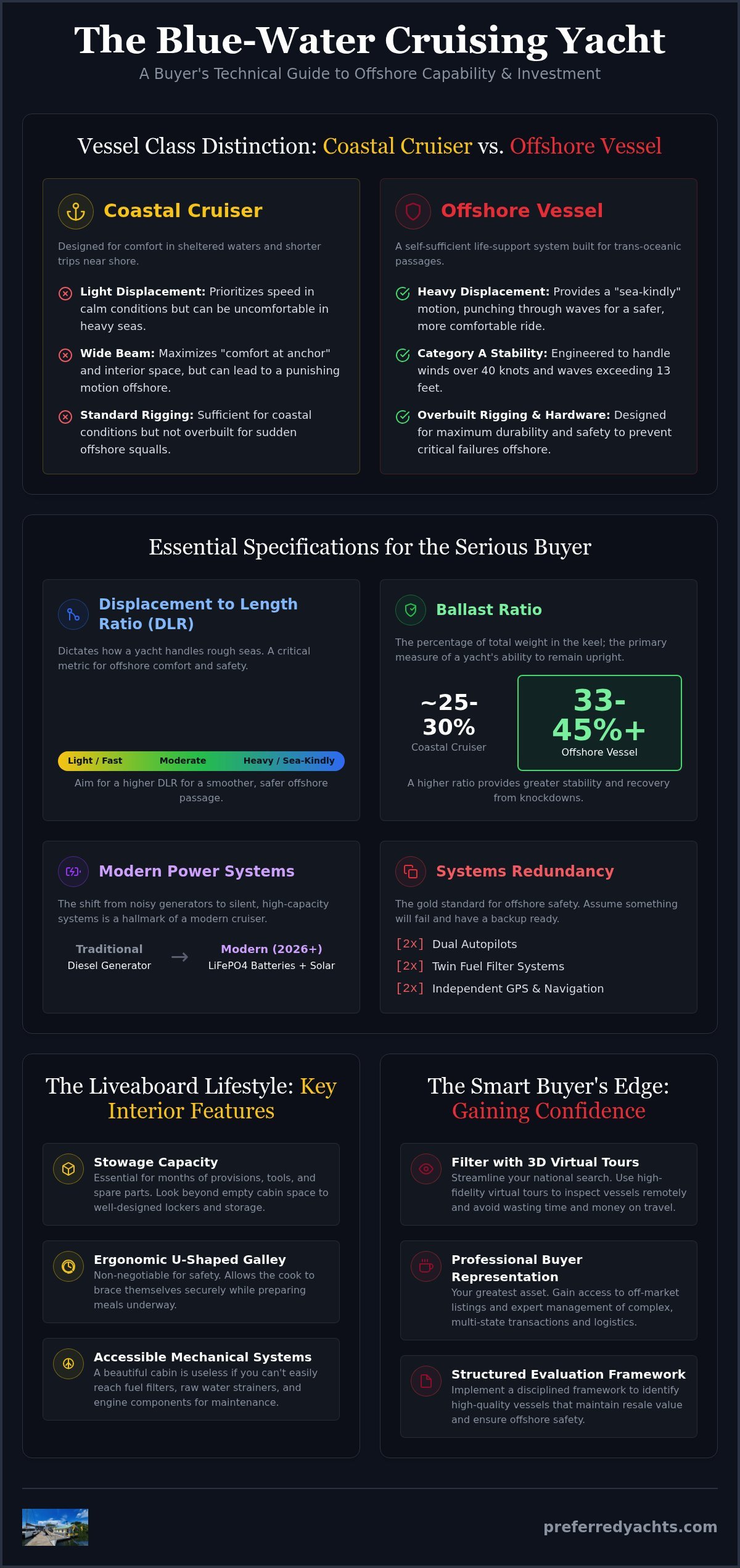
The distinction between coastal and offshore vessels is often found in the scantlings and stability ratings. Coastal cruisers are typically light displacement boats designed for comfort in sheltered waters. They offer large cockpits and wide beams that provide "comfort at anchor" but can be punishing in a heavy seaway. For true blue-water passages, you must evaluate hull thickness and rig tension. An offshore vessel usually carries a Category A stability rating, meaning it's designed to handle winds over 40 knots and significant wave heights exceeding 13 feet. Rigging on these boats is overbuilt to prevent mast failure during sudden squalls; deck hardware is backed with heavy plates rather than simple washers.
The Liveaboard Lifestyle Transition
Living aboard requires a fundamental rethink of interior design. You'll need to prioritize stowage capacity for months of provisions and spare parts. An ergonomic galley is another non-negotiable feature. It should be U-shaped or secure enough to allow the cook to brace themselves while the boat is heeling. Climate control and ventilation are equally critical for extended stays in tropical or high-latitude environments. Look for boats with multiple opening ports and high-capacity fans. Finally, ensure the mechanical systems are accessible. A beautiful cabin is of little use if you can't reach the raw water strainer or the fuel filters when the engine dies in a narrow channel. Balancing luxury amenities with accessible, maintainable systems is the hallmark of a well-designed cruising yacht for sale.
Essential Specifications to Look for in a Cruising Yacht
Technical specifications provide the only objective way to filter a cruising yacht for sale before you commit to a physical inspection. One of the most critical metrics is the Displacement to Length Ratio (DLR). This number describes the relationship between a boat's weight and its waterline length, which directly dictates how the vessel handles rough seas. A higher DLR typically indicates a "sea-kindly" motion, meaning the boat won't toss the crew around as violently in a storm. While lighter boats are faster in light winds, an offshore cruiser needs enough mass to punch through waves without losing momentum.
Power systems have undergone a massive shift as we move into 2026. The traditional reliance on heavy, noisy diesel generators is fading. Modern cruisers now prioritize large LiFePO4 (lithium iron phosphate) battery banks integrated with high-efficiency solar arrays. This setup allows for silent operation of high-load appliances like air conditioning or induction stoves. Redundancy remains the gold standard for offshore safety; you should look for vessels equipped with dual autopilots, twin fuel filters, and independent GPS systems. The ballast ratio is the percentage of a yacht's total weight located in the keel, and it serves as the primary measure of the vessel's ability to remain upright or recover from a severe knockdown. You must also ensure the vessel meets all Federal requirements for recreational boats regarding safety gear and signaling before heading offshore.
Hull Design and Stability
Choosing between a full keel and a fin keel involves a trade-off between tracking and maneuverability. A full keel offers superior directional stability and protects the propeller from lobster pots or debris, but it makes the boat harder to turn in tight marinas. Conversely, a fin keel offers better performance and agility. For offshore work, a skeg-hung rudder is often preferred because the structural skeg protects the rudder post from impact damage. Material choices also matter; GRP remains popular for its ease of repair, while aluminum is favored by high-latitude sailors for its incredible strength and impact resistance.
Tankage and Self-Sufficiency
Self-sufficiency is the hallmark of a true cruiser. For a crew of four on a 10-day passage, you should look for a minimum water capacity of 200 gallons if the boat lacks a watermaker. Modern watermakers have revolutionized design, allowing for smaller, lighter tanks without sacrificing safety. Fuel is equally vital. A fuel polishing system is a non-negotiable feature for long-range power cruising; it prevents the "diesel bug" from clogging your injectors when you're 500 miles from the nearest mechanic. If you're ready to compare these technical frameworks across real-world examples, you can browse our current brokerage boats and yachts to see how different manufacturers approach these challenges.
Evaluating Quality Beyond the Listing: 3D Tours and Surveys
Static photography is a marketing tool, not an inspection tool. When you're searching for a cruising yacht for sale across the country, relying on owner-provided photos is a significant risk. These images are often outdated or carefully angled to hide moisture stains, cramped engine layouts, or worn upholstery. To truly understand a vessel's condition, you need a high-fidelity digital framework that provides an honest view of the boat's current state. High-quality listings now move beyond simple galleries to provide a transparent look at the vessel's soul.
The evolution of 3D technology has transformed the national yacht search. By using immersive walkthroughs, you can experience the flow and ergonomics of a vessel from your home office. This level of detail allows you to identify red flag areas that traditional photography ignores, such as corrosion on bilge pumps or the actual accessibility of the sea cocks. It's about seeing the boat as it is, not as the seller wants it to appear. You can see examples of this level of transparency by viewing our brokerage boats and yachts, where we prioritize detailed visual data for remote buyers.
Immersive 3D Walkthroughs for Remote Buyers
A professional 3D tour allows you to verify engine room access and bilge cleanliness with incredible precision. You can virtually stand in the galley to see if the layout works for offshore cooking, a point we touched on regarding ergonomic designs. One of the greatest benefits is the ability to measure spaces within the virtual environment. If you're planning to install a specific lithium-ion battery bank or a new watermaker, you can confirm fitment before ever booking a flight. This technology saves thousands in wasted travel costs by filtering out vessels that look good in photos but fail the digital inspection.
The Critical Pre-Purchase Yacht Survey
While digital tools filter your options, the pre-purchase survey confirms the final decision. You must distinguish between a standard Condition and Valuation survey and a dedicated mechanical sea trial. A SAMS (Society of Accredited Marine Surveyors) or NAMS (National Association of Marine Surveyors) certified professional is essential. They possess the technical expertise to find delamination in the hull or moisture in the deck that a camera cannot see. These findings aren't just deal-breakers; they are your primary lever in price renegotiation. A professional survey ensures you're buying a seaworthy vessel at a fair market price, protecting your investment from the start.
Navigating the National Market: From Search to Sea Trial
Finding a cruising yacht for sale that meets your specific requirements involves a disciplined five-step sequence. First, you must identify the right "class" of vessel for your mission. An offshore vessel designed for ocean crossings has different structural needs than a boat intended for coastal island hopping. Once you've narrowed the category, perform deep-dive digital inspections using the high-fidelity 3D tours we discussed. This filters out the fleet before you move to a formal Offer to Purchase. This legal document must include strict contingencies for a professional survey and a successful sea trial. Finally, you'll navigate the closing process, where title transfer and documentation require meticulous attention to detail to protect your investment.
The transition from a digital search to a physical inspection is where many buyers feel the most anxiety. A professional approach treats the purchase as a technical acquisition rather than an emotional one. By following a structured framework, you ensure that every system is verified and every legal protection is in place. If you're ready to start your search with a vetted inventory, explore our current brokerage boats and yachts to find a vessel that has already undergone our professional screening process.
Avoiding Common "For Sale" Pitfalls
Brokers often see "lipstick on a pig" in the used market. This refers to cosmetic upgrades like new cushions or a fresh coat of wax used to distract from structural delamination or an aging engine. The national market also contains "hurricane boats" or salvaged vessels that may have hidden salt-water intrusion in the wiring. You must verify the ownership history and ensure the boat has a lien-free status before any wire transfers occur. Ethical transaction management is the only way to avoid these expensive mistakes.
Mastering the Sea Trial
The sea trial is your only chance to verify performance under load. You need to run the engine at wide-open throttle (WOT) to monitor temperature stability and exhaust color. Black smoke suggests an overloaded engine or fuel issues, while blue smoke often indicates oil consumption. This is also the time to verify all electronics and house systems under real-world vibration. Listen for hull shudder or rig noise during high-stress maneuvers, as these can signal structural weaknesses that are invisible at the dock.
Why Professional Buyer Representation is Your Greatest Asset
The search for a cruising yacht for sale often involves navigating a landscape of conflicting interests. A listing broker represents the seller and has a legal obligation to secure the highest possible price. In contrast, a professional buyer's agent has a fiduciary duty to you. This means they're legally bound to put your interests first, providing a necessary counterweight during the transaction. Beyond legal protection, an experienced broker provides access to "off-market" listings that never reach public marketplaces. These are often high-quality vessels owned by sailors who prefer a discreet sale or are waiting for the right buyer through a trusted professional network.
A seasoned broker acts more like a mentor than a salesperson. They provide an objective "no" when a vessel, however beautiful, doesn't fit your specific mission. If you plan to cross the Atlantic but fall in love with a light-displacement coastal cruiser, your agent will explain why that choice compromises your safety. They also manage the critical escrow process. High-value transactions involve significant deposits; a professional brokerage ensures these funds are held in a secure, bonded account, protecting your capital throughout the evaluation period. This layer of security is vital when dealing with national or international sellers where legal recourse can be difficult.
The Broker’s Role in Negotiation
Effective negotiation isn't about aggression; it's about using concrete data. Your representative uses comparable market data to justify a fair market value offer, removing the guesswork from the process. This becomes especially important when survey results reveal necessary repairs. Owners are often emotionally attached to their boats and may resist price drops. A broker navigates this "owner-to-buyer" friction, securing post-survey credits or repair allowances without collapsing the deal. They ensure the final price reflects the vessel's actual condition, not its sentimental value.
Coordinating Complex National Transactions
Purchasing a cruising yacht for sale across state lines introduces significant logistical and legal hurdles. Your agent handles U.S. Coast Guard documentation and ensures all title transfer requirements are met to avoid future lien issues. They also coordinate the final closing steps, ensuring all paperwork is executed correctly before funds are released. If the boat is located far from your home port, they can arrange professional yacht transport or vet delivery captains to move the vessel safely. Explore our current cruising yacht inventory to see professional representation in action and discover vessels that have already undergone our rigorous screening process.
Secure Your Future on the Water
Securing a vessel that serves as both a home and a life-support system requires a blend of technical discipline and professional guidance. You now have the framework to evaluate hull stability, tankage, and modern power systems with the precision of a seasoned sailor. By utilizing high-fidelity 3D tours to filter listings and relying on expert buyer representation, you can navigate the complexities of the national market without the risk of an expensive mistake. Professional advocacy ensures your interests remain the priority throughout every negotiation and survey.
Since 1984, Preferred Yachts has provided the brokerage excellence and ethical transaction management needed for these high-stakes transitions. Our team specializes in professional 3D virtual tour production, allowing you to conduct deep-dive inspections from anywhere in the world before committing to travel. When you're ready to find a cruising yacht for sale that truly fits your mission, we're here to act as your mentor and advocate. Browse our curated brokerage yachts and experience our 3D virtual tours to begin your journey with confidence. The horizon is waiting, and with the right partner, your offshore dreams are well within reach.
Frequently Asked Questions
What is the most important feature to look for in a cruising yacht for sale?
The most important feature is the vessel's structural integrity and its ability to handle offshore conditions safely. While luxury amenities are attractive, a yacht's ballast ratio and hull construction determine its seaworthiness in heavy weather. You should prioritize a boat with a Category A stability rating and a hull design that offers a sea-kindly motion. This ensures the crew remains safe and comfortable during long passages.
How much should I budget for maintenance after buying a used cruising yacht?
You should generally budget approximately 10% of the boat's market value for annual maintenance and operating costs. This figure covers routine engine servicing, bottom painting, and the eventual replacement of standing rigging or sails. Older vessels or those with complex systems like watermakers may require a higher percentage to maintain their blue-water readiness. Consistent maintenance is the only way to preserve the vessel's resale value over time.
Do I really need a professional buyer agent if I found the boat myself online?
A professional buyer agent is essential because they provide a fiduciary duty to protect your interests during the transaction. Even if you found a cruising yacht for sale online, an agent manages the complex legal documentation and escrow process. They act as an objective mentor, helping you avoid emotional decisions that could lead to purchasing a vessel with hidden structural issues or undisclosed liens.
Can I conduct a sea trial before making a formal offer?
In the United States, a sea trial typically occurs only after a formal Purchase and Sale Agreement is signed and a deposit is placed in escrow. This standard practice ensures that only serious buyers utilize the seller's time and fuel resources. The contract includes a contingency clause that allows you to reject the vessel or renegotiate the price if the sea trial reveals performance issues under load.
What is the difference between a coastal cruiser and a blue water yacht?
The primary difference lies in the vessel's stability ratings and its capacity for self-sufficiency. Coastal cruisers are designed for light-air performance and comfort in sheltered waters with frequent access to shore power. Blue water yachts feature heavier displacement, overbuilt rigging, and significantly larger fuel and water tankage. These specifications are necessary to sustain the crew during multi-week ocean passages without outside assistance.
How long does the typical yacht closing process take in the United States?
The typical yacht closing process in the United States takes between 30 and 45 days from the initial offer to the final title transfer. This timeline allows sufficient time for the professional survey, the sea trial, and the resolution of any post-survey repair credits. Complex transactions involving multi-state documentation or international flagging requirements may extend this period slightly depending on the jurisdiction.
How do 3D virtual tours help in the yacht buying process?
3D virtual tours allow you to conduct a detailed digital inspection of a cruising yacht for sale before investing in travel costs. These tours provide an honest, 360-degree view of the engine room, bilge, and storage areas that static photos often overlook. This technology has become a standard for serious remote buyers, enabling them to filter out unsuitable vessels with high precision and transparency.
What certifications should I look for in a yacht surveyor?
You should only hire a surveyor who is accredited by the Society of Accredited Marine Surveyors (SAMS) or the National Association of Marine Surveyors (NAMS). These organizations enforce strict ethical standards and technical requirements for their members. Choosing a certified professional ensures that your survey report is accurate and accepted by insurance companies and financial institutions during the purchase process.