

25 Essential Questions to Ask a Yacht Broker Before Buying or Selling
Would you trust a stranger to manage a multimillion-dollar asset based on nothing more than a handshake and a glossy brochure? Most buyers and sellers realize that the maritime market is far more complex than it appears on the surface. You're likely feeling the weight of potential undisclosed hull damage or the headache of managing 2026's new 10% global surcharge on imported yachts. It's natural to feel anxious about whether your interests are truly being protected. Knowing the right questions to ask a yacht broker is the only way to transform that uncertainty into a position of strength.
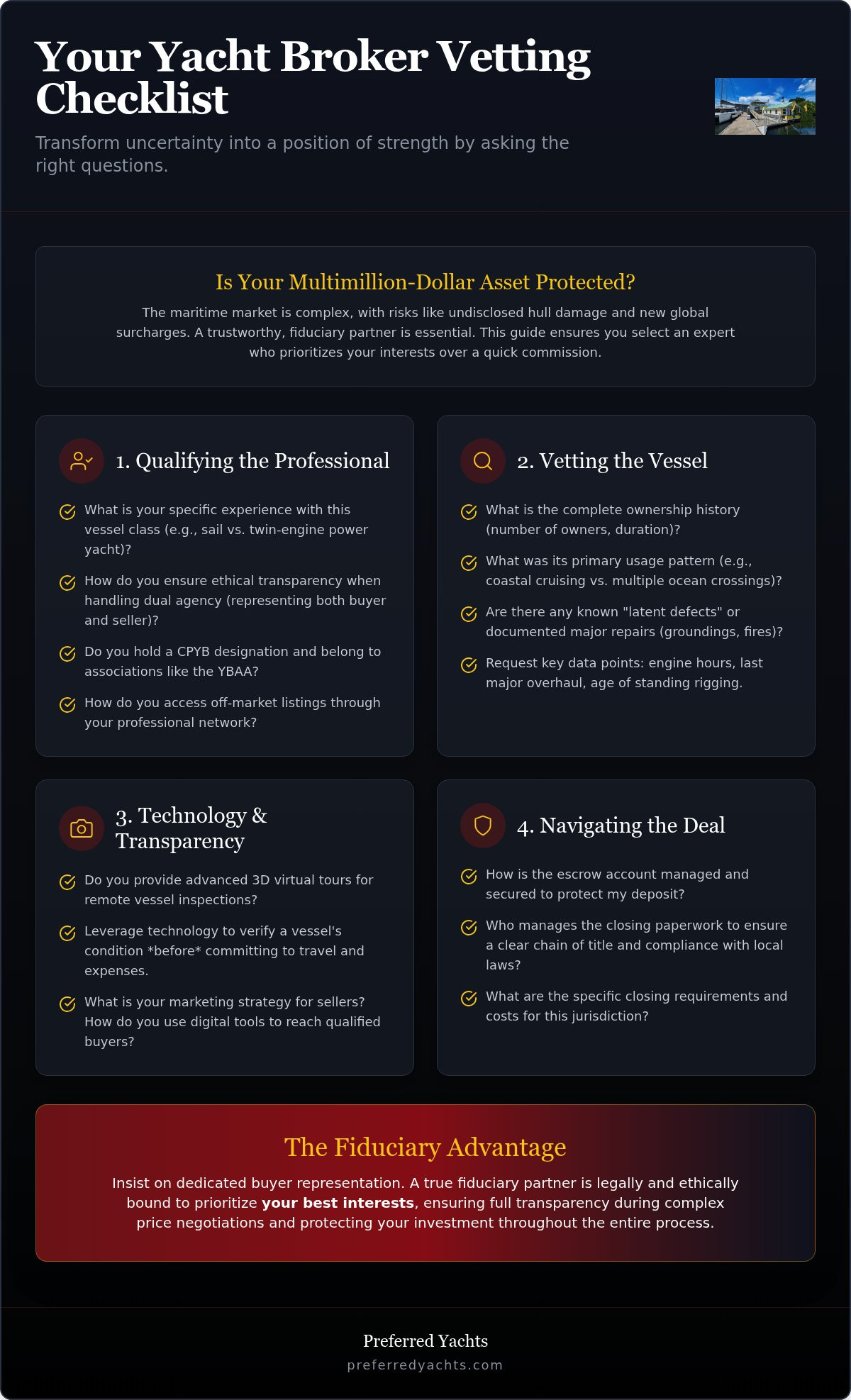
This guide provides the clarity you need to move forward with absolute certainty. We've compiled the 25 essential questions to ask a yacht broker to ensure you're partnering with a fiduciary who prioritizes ethics over a quick commission. You'll learn how to audit a professional's track record, verify the actual condition of a vessel through tools like 3D virtual tours, and master the nuances of a legally sound closing process. By the end of this article, you'll have a roadmap for securing a trustworthy partner and a vessel that meets your exact standards.
Key Takeaways
- Identify professional excellence by vetting a broker's specific class expertise and their standing within recognized maritime industry associations.
- Leverage advanced 3D virtual tour technology to conduct thorough remote inspections and verify a vessel’s condition before committing to travel.
- Protect your investment by learning the essential questions to ask a yacht broker about escrow account security and local closing requirements.
- Discover the strategic advantage of dedicated buyer representation and how a fiduciary partner ensures transparency during complex price negotiations.
- Avoid costly mistakes by uncovering a vessel’s true history, including past usage patterns and any documented structural repairs.
Qualifying the Professional: Questions to Ask When Choosing Your Yacht Broker
Selecting a broker is the foundation of a successful maritime transaction. You're hiring a consultant to manage a significant financial and legal process, not just a salesperson. One of the primary questions to ask a yacht broker involves their specific experience with your chosen vessel class. A sailing enthusiast might not grasp the technical nuances of a twin-engine power yacht's stabilizer systems or fuel management. You need a partner who speaks the language of your specific boat to ensure they can identify potential red flags during the initial walkthrough.
Transparency is paramount in this relationship. Ask directly how they handle dual agency. If a broker represents both the buyer and the seller, they must navigate a delicate balance to remain ethical. A trustworthy professional will explain their disclosure process and how they protect your interests during negotiations. Similarly, inquire about their market analysis methods. They shouldn't just look at what's currently listed on public sites. They should analyze actual "sold" data from the last six to twelve months to ensure the purchase price or listing price aligns with real market value rather than optimistic speculation.
Evaluating Professional Credentials and Industry Ethics
Look for the Certified Professional Yacht Broker (CPYB) designation. This isn't just a title; it's a mark of rigorous testing and a commitment to continuing education. Membership in associations like the Yacht Brokers Association of America (YBAA) provides an extra layer of security. These organizations enforce a strict code of ethics that protects you from predatory practices. Ask if they have a history of resolving disputes through professional mediation. A well-structured firm also employs dedicated support staff to manage the mountain of paperwork involved in a closing, ensuring no detail is overlooked in the chain of title.
Understanding the Broker's Network and Market Reach
The best opportunities often never reach public listing sites. Ask how your broker accesses "pocket" or off-market listings through their professional network. To gain a deeper perspective on the industry's standards, it's helpful to review what is a yacht broker and the fiduciary duties they owe to their clients. A seasoned professional maintains strong relationships with national firms, surveyors, and marine documentation specialists. This network allows them to move quickly when a high-quality vessel becomes available. If you're looking for a partner with this level of established reach, exploring our brokerage boats and yachts can show you the standard of representation you should expect in today's market.
Vetting the Vessel: Questions to Ask About a Specific Yacht Listing
Once you're satisfied with your representative’s professional standing, your focus must shift to the specific asset. The questions to ask a yacht broker at this stage are designed to peel back the layers of a vessel’s past. Start with ownership history. A yacht that has had three owners in ten years tells a very different story than one that has changed hands every eighteen months. You should also distinguish between coastal use and offshore voyaging. A boat that has spent its life in protected bays has faced less structural stress than one that has completed multiple ocean crossings.
Accuracy in disclosure is a legal and ethical necessity. Brokers must inform you of any "latent defects." These are hidden problems, such as internal hull delamination or faulty wiring, that wouldn't be obvious during a standard walk-through but could compromise safety. In major maritime hubs, these obligations are often codified in law, similar to the broker licensing requirements found in Florida's statutes. Don't hesitate to ask for a documented history of major groundings, fires, or structural repairs. For sailors, the age of the standing rigging is a non-negotiable data point. For powerboat buyers, engine hours and the date of the last major overhaul are the most important metrics.
Uncovering the Ownership and Maintenance Narrative
Every boat has a narrative. Ask why the current owner is selling. This isn't just curiosity; it helps you gauge the seller's motivation and how they've treated the vessel. You should demand to see the maintenance logs and service records. If these aren't available, it's a significant red flag. It's also critical to know if the yacht was ever part of a charter fleet. While charter companies often follow strict maintenance schedules, these boats typically endure much higher engine hours and more aggressive wear on interior finishes than those in private use. A private vessel with a consistent captain usually offers a more predictable maintenance history.
Identifying Potential Red Flags and Disclosure Obligations
Don't settle for vague descriptions like "good condition." Ask for a specific list of upgrades performed in the last 36 months. This timeline shows whether the owner was investing in the boat's longevity or simply doing the bare minimum to get it sold. Inquire about the last professional survey findings as well. If the report is more than a year old, its relevance has faded. You need to know if the mechanical and electrical systems are currently in "turn-key" condition. If you want to see how we document these details for our clients, feel free to review our available brokerage boats and yachts. This will give you a benchmark for the level of transparency you should expect from any listing.
Transparency Through Technology: Questions About Marketing and Remote Viewing
The global luxury yacht market is projected to reach $14.61 billion by 2031. While the post-pandemic boom has stabilized, the first half of 2026 still saw 444 superyacht sales with a total volume of $4.56 billion. Buyers are now more calculated; they prioritize brand pedigree and technological transparency. When you are thousands of miles away from a potential vessel, you must rely on the broker's digital assets. One of the most critical questions to ask a yacht broker is whether they provide immersive 3D virtual tours for their listings. High-fidelity digital detail allows you to inspect the vessel's layout without the expense of international travel.
A static photo gallery can easily hide flaws or cramped quarters. In contrast, a 3D walkthrough provides a realistic sense of scale and condition. Ask your broker if their digital tools allow you to explore the engine room and bilges. These are the heart of the boat; seeing them in high resolution can reveal leaks, corrosion, or poor maintenance that a standard "beauty shot" might omit. You should also verify which platforms they use to ensure global visibility. A professional firm uses a mix of industry-specific databases and targeted digital ads to reach the right buyers in 2026's normalizing market.
Leveraging 3D Virtual Tours for Efficient Vetting
Digital tours serve as an essential filter. They save both buyers and sellers significant time by ensuring that only genuinely interested parties proceed to a physical showing. Ask if the virtual tour is current. A tour from a previous listing cycle doesn't reflect the boat's present condition. A modern 3D tour also includes a measurement tool. This allows you to verify if your existing equipment will fit in the lazarette or if the galley has enough clearance for your needs. This level of precision is a hallmark of professional broker standards within the industry.
Modern Marketing Strategies for Sellers
If you are selling, your broker's marketing strategy determines your final sale price. Smartphone snapshots are insufficient for a high-value asset. Inquire about their use of professional photography and drone footage. They should explain how they use social media and targeted digital ads tailored to specific yacht types. A key differentiator in the current market is Preferred Yachts' 3D virtual tour production. This technology provides an "open house" experience that is available 24/7 to a global audience. It ensures that your vessel stands out in a market where buyers are increasingly discerning and calculated.
Navigating the Deal: Questions Regarding Compliance, Escrow, and Closing
Once you move past the initial viewing, the transaction enters its most critical phase. The questions to ask a yacht broker now must center on financial security and legal compliance. You need to know exactly how your earnest money deposit is handled. A professional brokerage always uses a dedicated, third-party escrow account to secure these funds. This protects your capital while the due diligence process unfolds. If a broker suggests placing the deposit into a general operating account, it is a significant red flag that warrants immediate caution.
The closing process itself varies significantly by jurisdiction. You should ask for a step by step breakdown of the timeline from the moment the survey is completed to the final exchange of title. In 2026, buyers must also account for shifting regulatory costs, such as the 10% global surcharge on imported yachts and state specific sales tax caps. For example, Florida currently caps sales tax at $18,000, while South Carolina's cap is just $500. A knowledgeable broker will help you navigate these financial nuances to ensure your closing costs are accurately calculated and legally sound.
Managing the Legal and Financial Safeguards
Verifying a clear title is non-negotiable. Ask your broker about their process for conducting lien searches and ensuring the vessel is free of encumbrances. If you're looking at international vessels, you'll need to know the specific documentation required for USCG documentation or foreign flagging. A vital part of this phase is the "Acceptance of Vessel" form. This document is signed after the survey and sea trial. It officially confirms that you are moving forward with the purchase, either as is or subject to specific repairs or price adjustments. Understanding this document's weight is essential before you sign anything.
Coordinating the Survey and Sea Trial
The survey is your final chance to uncover hidden issues. You should ask who is responsible for the haul out costs; typically, the buyer pays for the surveyor and the haul out while the seller ensures the boat is accessible. Your broker should coordinate with marine surveyors and engine technicians to ensure all systems are tested under load during the sea trial. If the trial reveals significant undisclosed issues, you need a clear path for rejection or renegotiation. Most contracts provide a specific timeline, often 24 to 48 hours after the survey, to submit your conditional acceptance or rejection. If you're ready to partner with a team that manages these complexities with 40 years of experience, explore our brokerage boats and yachts to start your journey with professional representation.
Strategic Advocacy: Why Professional Buyer Representation is Essential
Many first-time buyers make the mistake of calling the listing agent directly when they see an attractive vessel. While this seems efficient, it creates a fundamental conflict of interest. The listing agent's primary fiduciary duty is to the seller; their goal is to secure the highest possible price and the most favorable terms for their client. By securing your own representation, you gain an advocate whose sole objective is to protect your interests. One of the most important questions to ask a yacht broker when interviewing them is how they specifically manage this professional boundary. A dedicated buyer’s agent acts as a necessary buffer during emotional negotiations, ensuring that logic and market data drive the final decision rather than excitement.
The cost of this professional advocacy is often a point of confusion for new buyers. In the standard maritime transaction, the seller pays the brokerage commission, which is typically 10% of the final sale price. This fee is then split between the listing firm and the firm providing the Preferred Yachts buyer representation service. This means you receive expert guidance, legal protection, and technical vetting at no direct cost to you. Your agent handles the complex coordination with surveyors, technicians, and documentation specialists, allowing you to focus on the vessel itself while they manage the logistical friction.
The Fiduciary Duty of a Buyer's Agent
A true professional operates as your fiduciary. This means they are legally and ethically bound to put your interests above their own or the seller's. They will point out flaws that a listing agent might gloss over and provide objective analysis of a vessel's true value. Having an expert who isn't emotionally attached to the boat is invaluable during the survey and sea trial phases. They help you stay grounded when significant repairs are uncovered, advising you on whether to renegotiate the price or walk away from the deal entirely. This objective distance is the only way to avoid the "buyer's remorse" that often follows an impulsive, unrepresented purchase.
Beyond the Sale: Long-Term Support and Guidance
The relationship with a high-quality broker shouldn't end when the funds are transferred. You should include questions to ask a yacht broker regarding their post-sale support. Ask how they assist with finding reputable service providers or local slip availability. A broker with decades of experience has a deep network of trusted mechanics, riggers, and delivery captains. They can guide you through your first few months of ownership, offering insights into local cruising grounds and vibrant yachting communities. This level of commitment transforms a simple transaction into a lifelong maritime partnership, ensuring you feel confident on the water for years to come. A great broker doesn't just sell you a boat; they become your most trusted maritime advisor.
Securing Your Future on the Water
Mastering the right questions to ask a yacht broker empowers you to navigate the complexities of the 2026 market with absolute confidence. You now understand the importance of vetting a professional's standing through industry associations, utilizing high-fidelity 3D virtual tours for remote inspections, and ensuring your earnest money is protected in dedicated escrow accounts. These steps transform what could be a high-stakes transaction into a controlled and transparent process. By focusing on professional credentials and technical transparency, you protect both your capital and your peace of mind.
At Preferred Yachts, we bring over 40 years of brokerage excellence to every deal, acting as a dedicated fiduciary for our clients. Whether you're leveraging our specialized 3D virtual tour marketing to sell your vessel or seeking expert advocacy as a buyer, our team provides the stability and expertise you deserve. Contact Preferred Yachts for Expert Buyer and Seller Representation to begin your next chapter with a partner you can trust. Your maritime dream is within reach when you have the right advisor by your side.
Frequently Asked Questions
Do I need a yacht broker to buy a boat privately?
You aren't legally required to use a broker for a private sale, but it's highly recommended to protect your capital. A professional broker manages the title search, ensures the vessel is free of liens, and handles the secure transfer of funds through an escrow account. Without this oversight, you risk inheriting the previous owner's legal or financial liabilities.
Who pays the yacht broker's commission, the buyer or the seller?
The seller typically pays the brokerage commission, which is generally 10% of the final sale price. This commission is usually split between the listing broker and the buyer's representative. This arrangement allows buyers to receive expert fiduciary advocacy and technical guidance throughout the purchase process at no direct cost to them.
What is the difference between a listing broker and a selling broker?
A listing broker represents the seller's interests and focuses on marketing the vessel to achieve the highest price. A selling broker, often called a buyer's agent, represents the buyer's interests exclusively. Identifying this distinction is one of the most important questions to ask a yacht broker to ensure you have an advocate who is focused on your specific needs rather than the seller's goals.
How long does the typical yacht purchase process take from offer to closing?
The standard yacht purchase process usually takes between 30 and 45 days. This timeline includes the initial offer, the ten percent earnest money deposit, the marine survey, and the sea trial. Complex transactions involving international flagging or foreign built yachts may take longer due to 2026's updated import regulations and documentation requirements.
Can a yacht broker help with marine insurance and financing?
A broker doesn't sell insurance or provide financing directly, but they act as a vital bridge to reputable marine specialists. They understand the specific documentation that lenders and insurers require, such as survey reports and proof of clear title. This expertise helps you gather the necessary paperwork to streamline your approval process with third-party providers.
What should I look for in a yacht survey report?
Focus on safety related findings often categorized as "Priority 1" issues, such as structural delamination, faulty fire suppression systems, or mechanical failures. You should also look for the surveyor's estimated fair market value. These details are essential for your final negotiation and for satisfying the requirements of your insurance provider.
Is a sea trial always necessary before buying a yacht?
A sea trial is an absolute necessity to verify that all systems function correctly under load. It's the only opportunity to test engine performance at wide open throttle, check the operation of stabilizers, and observe the vessel's handling characteristics. Skipping this step can lead to expensive surprises that a static inspection simply won't uncover.
How do I verify a yacht broker's professional reputation?
Check for the Certified Professional Yacht Broker (CPYB) designation and active membership in organizations like the International Yacht Brokers Association (IYBA). These credentials indicate that the broker has passed rigorous testing and adheres to a strict code of ethics. Adding these checks to your questions to ask a yacht broker ensures you're partnering with a vetted professional.